Best AI SEO: How to Choose and Implement the Right AI-Assisted SEO Workflow
Working Of Seo When people search for "best ai seo," they are not necessarily looking for one product. In many cases, they are trying to solve a broader operational problem: where AI belongs in the SEO workflow, which tasks it can support, how much human review is still required, and how to determine whether a capability fits their site and team.

That distinction matters because SEO combines research, content planning, technical validation, publishing, internal linking, maintenance, and measurement. AI may assist with some of these activities while being unsuitable for others. It can organize information and generate alternatives, but it does not automatically understand an audience, verify every claim, identify the most important business priority, or confirm the live condition of a website.
This guide does not recommend a single product or promise higher rankings, traffic, indexing, or inclusion in AI-generated answers. Instead, SEO Console: build an SEO fix plan from a small crawl | CMS SOP it provides a framework for evaluating AI-assisted SEO capabilities and a controlled path for introducing them into an existing workflow.
What "Best AI SEO" Should Mean
The word "best" is not useful when it is treated as a universal ranking. A capability that fits a large content operation may be unnecessary for a small team. A workflow designed for educational articles may not fit product pages, documentation, comparison content, commerce pages, or regulated topics. A system that produces useful suggestions may still create extra work if its output cannot be reviewed, transferred, and maintained within the existing process.
Site Construction Company For practical purposes, the best AI SEO approach is the one with the strongest fit for a specific site’s current stage, content type, team capability, technical environment, budget, language requirements, integration needs, and verification process. The objective is not to maximize the number of AI features. It is to support repeatable work without weakening accuracy, originality, accountability, security, or maintainability.
Start by identifying the actual constraint. If the problem is a disorganized content inventory, classification and clustering may help. If the problem is weak editorial quality, producing more drafts may not solve it. If the problem is technical accessibility, an AI-generated checklist cannot replace access to the site and validation in the relevant environment.
Where AI Can Enter the SEO Workflow
AI is generally most useful as an assistive layer around repeatable information-processing tasks. Its role should be defined Order Instant Licence Delivery | CMS SOP by the quality of the inputs, the importance of the decision, and the review required before publication or implementation.
Keyword Research and Topic Organization
Given a supplied keyword set or collection of questions, AI can group related phrases, cluster possible search intents, identify similar wording, surface apparent overlaps, and expand a topic into natural-language questions and subtopics. It can also help organize a large inventory into a more manageable review queue.
These outputs are candidates, not confirmed demand signals. AI cannot independently establish whether a topic matters to a real audience, supports a business priority, fits the site’s expertise, or is feasible AI GEOmetry Helper in the competitive environment. Human reviewers should compare suggestions with available site data, audience knowledge, existing pages, business objectives, and the evidence available for the proposed topic.
Content Briefs and First Drafts
After a topic has been selected and the inputs are clear, AI can help turn requirements into a content brief. It may suggest headings, questions to answer, section order, alternative titles, or a first draft. It can also support rewriting for clarity, reducing repetition, expanding an explanation, and maintaining consistent terminology across related pages.
A draft is not fact verification, audience insight, professional experience, original research, or final editorial judgment. Before publication, someone must check factual claims, source quality, context, originality, usefulness, terminology, and whether the page genuinely answers the intended question. Topics that depend on current information, specialist knowledge, first-hand experience, or regulated requirements need especially clear human ownership. Contact UK BIG SEA | Cms Sop product and purchase support | CMS SOP
Technical SEO Checks
AI can organize a technical checklist, summarize supplied audit findings, group possible issues, and turn observations into implementation tasks. It may also help convert a long report into questions for developers, editors, or site owners.
Without reliable information about the actual website, AI cannot confirm the site’s condition. Recommendations about crawling, indexing, rendering, templates, links, structured information, or accessibility remain recommendations until they are checked in the relevant environment. A technically responsible person should validate the issue, assess its impact, approve the change, and confirm the result after implementation.
Internal Linking and Content Structure
When given reliable page titles, summaries, URLs, or other inputs, AI can suggest relationships between pages, identify internal-link candidates, group pages into topic clusters, and propose anchor-text alternatives.
A suggested relationship is not proof that a link is useful. Human review should confirm that the destination is relevant, accessible, accurate, and valuable to the reader. The link should also make sense within the site’s information architecture and user journey. Adding links solely because two pages share words can create noise rather than a clearer structure.
Metadata and Structured Information Drafting
AI can produce candidates for page titles, descriptions, summaries, and other structured fields. It can compare fields across a page group and flag missing, duplicated, or inconsistent information, which may help prepare a review queue.
Generated metadata must remain faithful to the page. It should not exaggerate a benefit, imply evidence the page does not contain, or introduce unverified information. Structured information also requires validation against the actual page, the applicable implementation format, and the rendered result. A plausible-looking output is not evidence that an implementation is correct.
Content Updating and Maintenance
AI can compare supplied versions, identify passages that may be outdated or repetitive, organize update candidates, standardize terminology, and maintain a change record. It can help highlight pages that require closer review.
An update should respond to changed facts, audience needs, page quality, business priorities, or an observed problem—not simply add more words. Every changed factual claim still requires verification. A useful maintenance record should show what changed, why it changed, which inputs were used, who reviewed it, and which version was published.
How to Evaluate the Right AI SEO Capability
A sensible evaluation starts with the site and workflow rather than a feature list. Use the following questions before selecting or expanding an AI-assisted process.
1. What Is the Site’s Current Stage?
Is the site being built, expanded, consolidated, or maintained?
Is the main constraint missing content, duplicated content, weak structure, technical accessibility, limited maintenance capacity, or difficulty explaining results?
Does the team already have a repeatable process for auditing, producing, publishing, and updating content?
2. What Type of Content Is Being Produced?
Are the main assets educational articles, product pages, comparison pages, documentation, media pages, or commerce pages?
Which pages depend on expert review, first-hand information, current facts, original research, or regulated requirements?
Which tasks can be assisted by AI, and which must be led by a subject-matter expert or accountable editor?
3. Who Owns the Decisions?
An AI workflow needs clear responsibility. Identify who decides topic priority, validates facts, reviews expertise, approves technical changes, edits the content, and authorizes publication. If no one owns these decisions, adding AI may increase the volume of unreviewed work rather than improve the process.
The team should also be able to preserve inputs, instructions, generated versions, editorial decisions, factual checks, technical changes, and publication history. This separation makes it easier to distinguish an AI suggestion from a human decision and a verified fact from an assumption.
4. What Is the Total Cost?
The relevant cost is not limited to a subscription or usage fee. Consider data preparation, integration, training, migration, human review, maintenance, governance, security checks, and the time required to interpret outputs.
Ask whether the capability reduces repetitive work or creates another isolated system that requires manual data transfer. Check whether the output can be used by existing content management, analytics, reporting, review, and publishing processes. A lower direct cost may not be valuable if the workflow becomes harder to manage.
5. Are Language and Governance Requirements Clear?
Some teams need multiple languages, regional variants, multiple reviewers, permission controls, or audit records. Define what information may be entered into an AI system, who can access the outputs, how records are stored, and how client or sensitive information is handled. Specific requirements should be checked against the organization’s policies and applicable obligations.
Traditional SEO and AI Visibility Are Related but Not Identical
Traditional search visibility and visibility in generated answers may overlap in areas such as clear content, consistent facts, accessible pages, and strong topic relationships. That overlap does not make them the same measurement, and it does not make one a guaranteed substitute for the other.
A useful measurement framework should distinguish between being discovered, being mentioned, being cited, generating a visit, and contributing to a business outcome. These are different events and may require different data sources. One answer display, monitoring observation, or ranking change should not be treated as proof of stable visibility or business impact.
Any observed change depends on the site, content foundation, implementation, query conditions, platform behavior, competing pages, and observation period. AI-assisted work may support clearer and more organized content, but no workflow can responsibly promise rankings, crawling, indexing, traffic, AI citations, or commercial results in advance.
Common Misuse and Risk Areas
Publishing AI output without factual, editorial, source, audience, or subject-matter review.
Using repeated keywords as a substitute for answering the user’s question and providing independent value.
Treating generic generated text as first-hand experience, professional expertise, original research, or trustworthy sourcing.
Ignoring experience, expertise, authoritativeness, and trust considerations when a topic depends on expert knowledge, current facts, or sensitive decisions.
Treating an AI-generated technical recommendation as proof of a real website problem without checking the live environment.
Expecting one audit, ranking observation, or AI-answer screenshot to prove a stable result.
Optimizing for output volume while neglecting topic selection, fact checking, expert input, editing quality, and maintenance.
Ignoring information security, access control, confidentiality, regulatory review, and change accountability.
A Practical Implementation Path
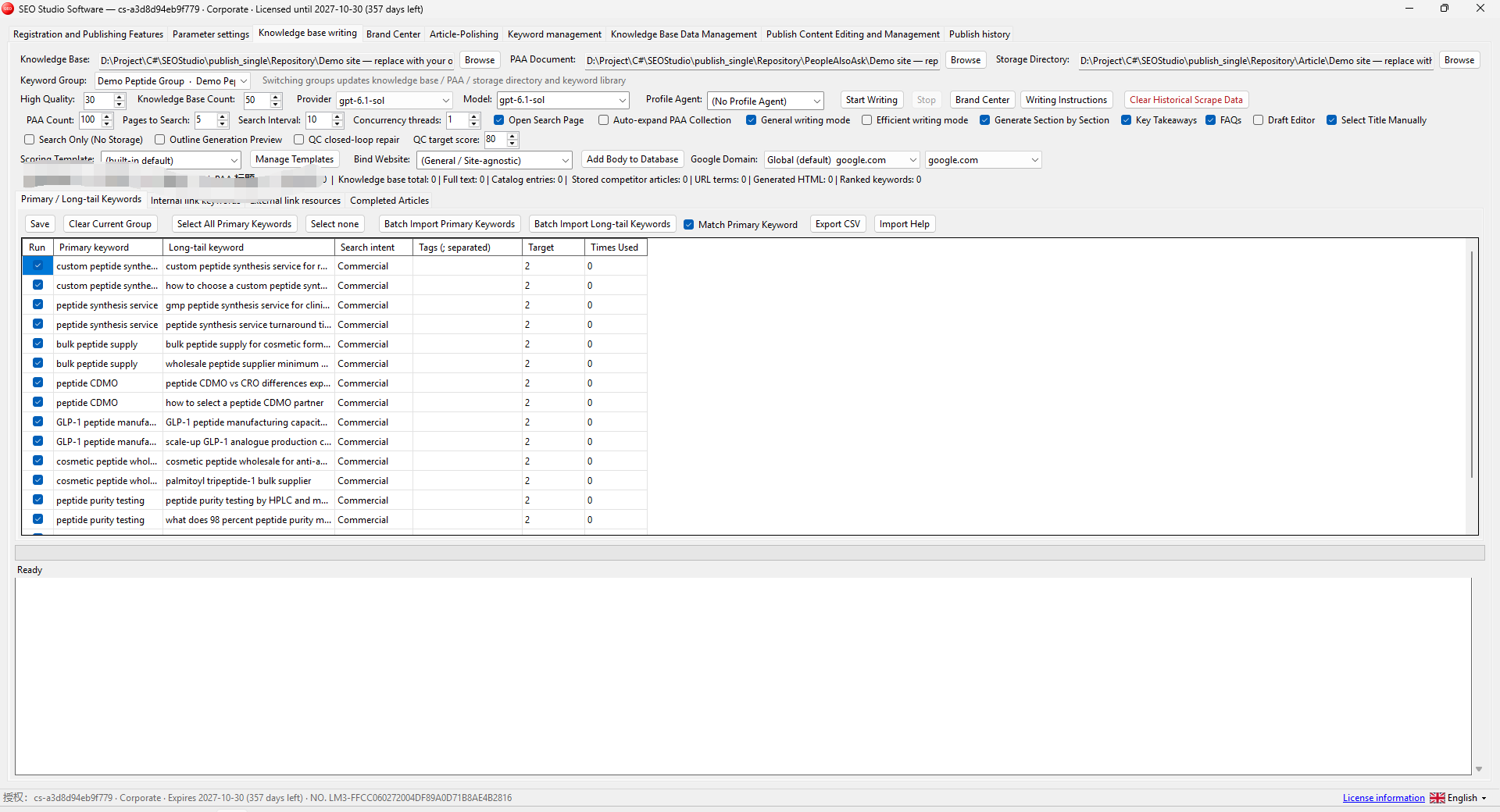
A controlled implementation can follow this sequence: content audit → keyword and topic opportunity screening → AI-assisted production workflow → technical checks → publication and monitoring iteration.
1. Start with a Content Audit
Choose one content cluster or limited group of pages rather than changing the entire site at once. Record each page’s purpose, audience, search intent, current status, update history, internal links, known sources, and open problems.
AI can help classify pages, identify repeated themes, organize gaps, and prepare an audit-table draft. People should confirm page priorities, factual condition, business relevance, and the need for specialist involvement. Keep a record of the criteria used and the reasoning behind important decisions.
2. Screen Keyword and Topic Opportunities
Place keywords, natural-language questions, existing pages, audience needs, business objectives, and available evidence into one decision view. AI can cluster expressions and propose relationships, while people confirm demand, relevance, feasibility, differentiation, and priority.
For each selected topic, record the target page, reason for selection, required evidence, responsible owner, and unresolved uncertainty. This prevents topic generation from becoming a disconnected activity that produces ideas without a clear publishing or validation path.
3. Design a Controlled Content Workflow
Place AI in defined support steps such as briefing, outlining, information organization, rewriting, and checklist generation. Keep fact checking, source assessment, expert review, differentiation, compliance review, editing, and publication under clear human responsibility.
Preserve input materials, generated versions, review notes, factual checks, editorial changes, and the final published version. This creates a traceable record and helps improve the workflow without confusing generated suggestions with approved content.
4. Complete Technical Checks
Check accessibility, links, page titles and descriptions, hierarchy, structured information, rendering, and the actual post-publication state. AI can organize checklists and summarize supplied findings, but it should not replace live validation or technical ownership.
For each issue, record the evidence, responsible person, implementation change, validation step, and unresolved uncertainty. A technically responsible person should confirm the problem and verify the result after the change is made.
5. Publish, Observe, and Iterate
Define the observation period and measurement sources before publishing a change. Separate content updates, search observations, page access, user behavior, leads, and other business-relevant signals rather than combining them into one unclear result.
For AI visibility, distinguish being mentioned, being cited, generating a visit, and contributing to a business outcome. AI can compare versions, organize monitoring notes, flag anomalies, and prepare follow-up questions. People must interpret possible causes and decide whether to continue, revise, or stop the experiment.
A Decision Checklist Before Adding AI SEO Capability
What specific workflow problem are we trying to solve?
Which task is repetitive enough to justify assistance?
What information must be supplied for the output to be useful?
Who validates facts, audience relevance, technical recommendations, and final publication?
How will the team record AI suggestions, human decisions, changes, and observations?
What would count as useful progress, and what cannot be inferred from the available data?
Does the workflow reduce effort without weakening accuracy, originality, accountability, security, or maintainability?
Conclusion: Choose the Best Fit, Then Test It Narrowly
"Best ai seo" is not a universal product verdict. The appropriate solution depends on the site’s stage, content type, team roles, technical stack, budget, language requirements, integration needs, and ability to verify outputs. A capability that fits one workflow may create unnecessary complexity in another.
AI can assist with organization, clustering, briefs, drafting, rewriting, checklists, internal-link candidates, metadata candidates, and maintenance records. It does not replace audience judgment, factual verification, expert review, technical validation, editorial responsibility, or careful interpretation of results.
This article does not provide a single-tool recommendation, product comparison, pricing assessment, performance case study, or ranking promise. No external source material was available for verifying such claims, so the guidance is intentionally limited to a general workflow framework.
The practical next step is small and concrete: choose one content cluster or limited page group, document its current state, identify the tasks AI may support, define the human approval points, and establish the observation record before expanding the workflow. If the process remains understandable, reviewable, and maintainable at that scale, it can provide a sound basis for further evaluation. It should not be expanded merely because an AI system can produce more output.