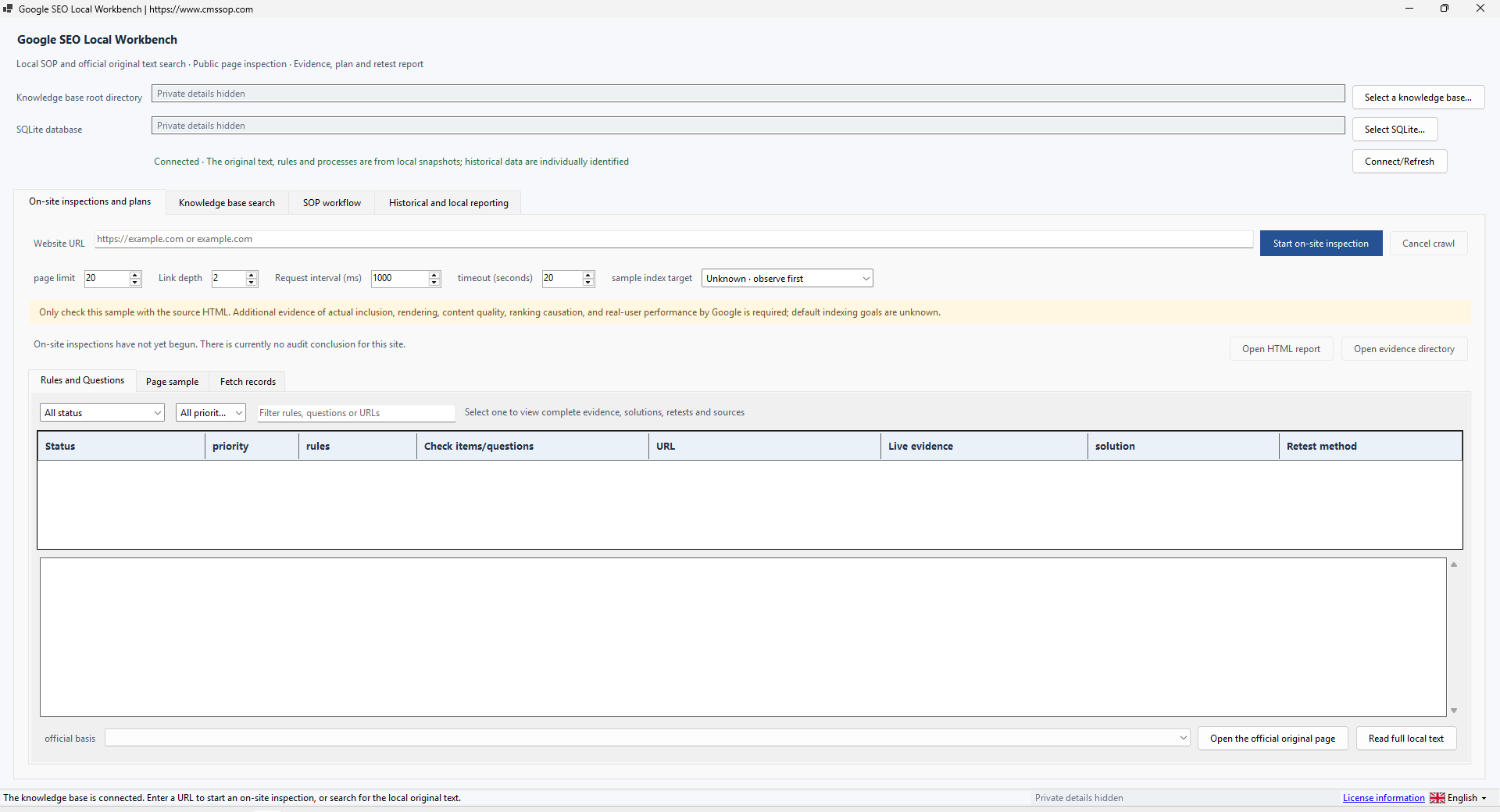
An SEO fix plan should tell you what to change, why the evidence supports it and how you will check the result. SEO Console helps organize a bounded HTML inspection and local reference material. Begin with a small website sample so you can read the findings, rather than treating the number of rows as a measure of progress.
Define the sample before the crawl
Choose a website you own or are authorized to inspect. Include a homepage, one product or service page, a useful article and a page whose behavior you already understand. Use a modest page limit, link depth and request rate. Record those settings with the report so another person can understand what the sample covers.
For example, a five-page product launch check is different from a review of an entire catalogue. A successful sample does not show that every page was inspected. If you need broader coverage, increase the scope only after checking that the first run reaches the right pages and handles the website normally.
Separate evidence from open questions
A fetched HTML response can show a title, a link or an indexing directive. It does not, by itself, establish what Google has indexed, how a browser renders every element or what causes a ranking change. Keep observations and unknowns separate in the SEO fix plan.
| Observation | Next check | Completion evidence |
|---|---|---|
| A sampled page has an unexpected title | Inspect its purpose and template | The correct title in a fresh response |
| A public page has noindex | Confirm whether exclusion is intended | The intended directive after review |
| A link leads to a missing page | Find the intended destination | A working link and the right landing page |
Google explains that a crawler must be able to access a page to see its noindex directive. Do not assume a robots.txt exclusion and a page-level noindex have identical effects.
Choose a small set of fixes
Start with findings that prevent a visitor from reaching or understanding an important page. A broken product link is a concrete task. A vague request to improve all content is not. Assign each task an owner, the affected URL and a short acceptance check.
Consider a second example: two pages contain the same title because they use one shared template field. Confirm that cause before editing each page separately. Fixing the template may be the right action, but inspect other pages using that template before making a broad change.
Retest the same condition
Repeat the relevant fetch after a change and compare it with the saved evidence. Check the actual destination as well as the HTTP status. A successful response containing an error message is still the wrong visitor experience. Save the new report with a date and a note explaining the difference.
Use Search Console or other appropriate evidence when the question concerns real indexing or search performance. Do not mark that question resolved because an offline or local HTML inspection completed.
Keep the handoff readable
A useful SEO fix plan may contain only a few tasks. Each should connect a specific observation to a decision and a retest. Keep the report and source references together. Read the SEO Console scope, the preflight workflow and the website launch checklist before expanding the audit.